From Candy Crush to Credit Scores: How Gamified Finance is Reshaping Money in India and Beyond
When saving money feels like winning a game

Introduction
Is it fun to save money? Yes, really, fun.
It’s the morning of Monday. You’re half asleep and looking through your phone before you even get out of bed. There’s a bright notification in the middle of all the news stories and spam emails:
“Day 4 of the Daily Financial Streak!” You have saved ₹20 today. “You’ve unlocked the Bronze Saver Badge!”
You’re not sure. Wait, did I earn a badge? To save money?
You tap the app to open it. When you reach your goal, a happy animation greets you. Your micro-investment roundups have put ₹600 into your gold account. You’re close to reaching your next goal. There is even a leaderboard that shows how you stack up against your pals.
It’s strangely satisfying. It also gives you hope.
A short time ago, your money was a mess of lost bank statements and last-minute EMIs. You know everything there is to know about your money now, not because you took a crash course in finance, but because your savings app is like a video game. It bothers you, pats you on the back, teases you, and wins.
This is the gamified world of personal finance, where managing your money isn’t boring, it’s a game you want to win.
Would you rather get a Bronze Saver Badge or watch your favorite TV without feeling bad?
Is this the way to give people more control over their money, or is it just another way to get them hooked on dopamine?
Your brain loves points, medals, and leaderboards without you even knowing it.
Gamification is based on how people think: we all want to move forward, do well, and get acceptance.
- Points, badges, streaks, and leaderboards are more than just design features. They are behavioral nudges that create feedback loops and rewards for motivation.
- Each task, like making SIPs or monitoring your credit score, is a mini-mission with clear progress.
For Millennials and Gen Z who grew up with Duolingo streaks, fitness app wins, and fantasy leagues, this gamification makes money seem safe and, oddly, entertaining.
Think about telling your parents that your “high score” is now ₹50,000 in a mutual fund. You aren’t putting things off anymore; you’re leveling up!
If your savings app had a final boss, would it be an evil EMI dragon or a cunning “unplanned subscription” goblin?
How Indian Fintechs Are Making Money Fun
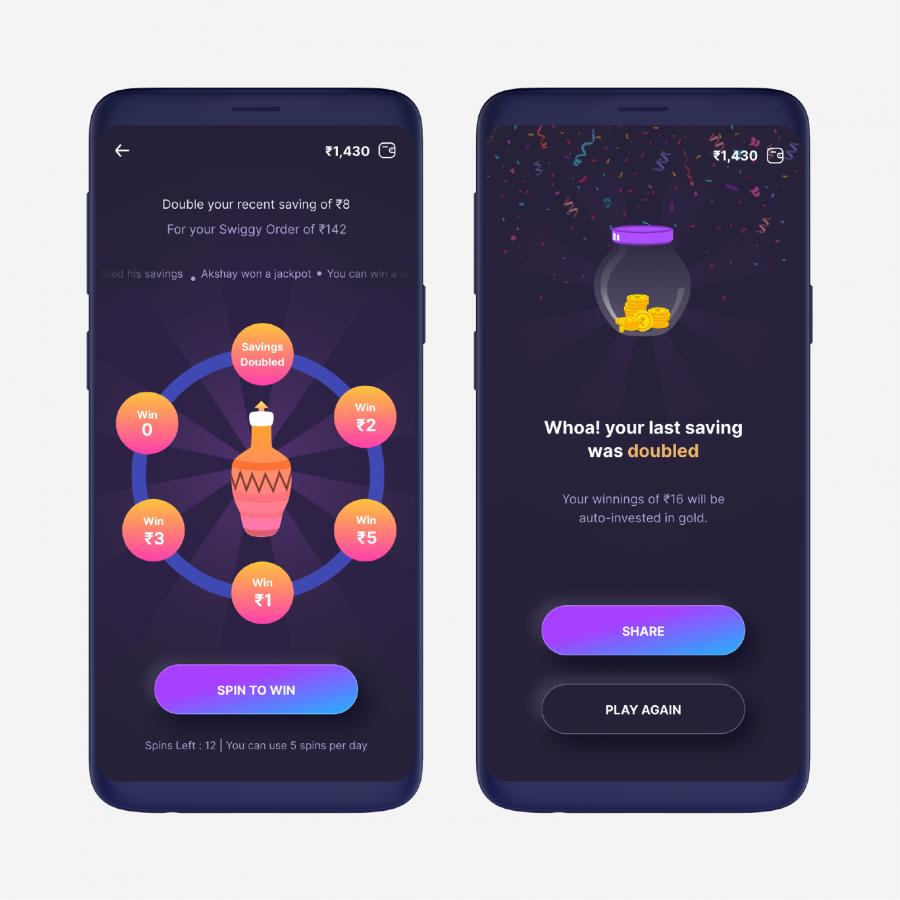
Money can suddenly be as hard to stop as Candy Crush. Really.
India’s fintech entrepreneurs aren’t just playing games; they’re putting a lot of money on the line:
- Jar: Encourages small saves by rounding up your internet purchases and turning your spare change into gold investments.
- StockGro and TradingLeagues: Let you trade stocks in virtual money and compete with others, making trading safer and more social.
- FitMoney: Uses daily reminders, games that help you build good habits, and budgeting goals to make learning about money fun.
And it’s not just for fun; it’s working:
- People are spending more than 30% more time on gamified finance apps.
- More than 7.5 million people use Jar every week.
- Every month, more than 35 million people use StockGro to practice trading.
Who would have imagined that clicking “Save ₹20” would make you feel better than your WiFi speed on game night?
Do you want to finally beat your cousin at Monopoly or top the StockGro leaderboard?
What Happens When Mr. Beast Joins the Game?
When fintech and YouTube stars get together, they make money and chaos.
MoneyLion, a US-based finance company, recently teamed up with YouTube star MrBeast to produce the Beast Games Giveaway. Customers may win prizes for things like logging in, taking money-smart training, and saving money in this $4.2 million competition.
This partnership:
- Brings money management to risky entertainment.
- Uses the reach of influencers to talk to millions of Gen Z buyers.
- In the first two weeks, app downloads went up by more than 200%.
Imagine telling your friend that you’re “racing against MrBeast” merely to save ₹50 a day. Level of flexibility: master.
If MrBeast made a savings challenge just for you, what silly prize would make you really hit “deposit”?
But is gamification always good for you?

Not every gold-plated badge has a gold star.
Pankaj Sharma of ET wrote a scathing op-ed about the dark side of gamification, especially in places like share trading where there are no rules.
“It’s good to save money. But it is bad to make investment addicting.” – ET Commentary
Critics are ringing the alarm for:
- Actions in addictive apps that are like casino slot machines.
- Investors who were misled into making high-risk wagers on fake trading wins.
- Not enough information about how users are being manipulated.
The issue lies not in gamification itself, but in its timing, location, and manner of implementation. Without ethical protections, even harmless things might lead people down If you keep “spinning” an imagined stock market, you might become a caffeine-guzzling, leaderboard-addicted night owl.
Would you risk smashing a virtual badge if it cost you ₹100 or maybe your marbles?
Are regulators trying to catch up?
Yes, and fast enough to make the fintechs sweat.
India’s regulators, RBI, SEBI, and IRDAI are starting to regulate this area. Some steps could be:
- Openly talking about gamified features.
- Unlicensed influencers are not allowed to give financial advice.
- Checking how apps work to find a balance between ethical design and openness.
Money is faith in finance. Any platform that uses gamification in the wrong way will eventually lose users’ trust.
Regulators can be considered as the parental controls on your fave app—but with more fines, and scarier.
Would you stop using a gamified finance app if the regulator said it was too much fun?
How to Play the Right Way
Play games, but don’t risk your life savings.
Fintech and investors are moving in the direction of:
- Gamify with a Purpose: Get people involved yet give them authority.
- Teach Real-Life Skills: Not just game-like habits.
- Balance Everything: Enjoyment goes along with basics.
- Work Creatively: Celebrity stunts are okay if used wisely.
“Gamified finance” is not a fad. If employed with honesty, it’s a change agent. – Anuradha Aggarwal, Dexter Ventures
If your app helps you budget and makes you laugh with every badge, you are winning at life.
If you could make your own gamified finance mission, what silly yet helpful task would it be?
Money is the New Game Board
Get more money in your wallet, one badge at a time.
As India’s financial industry matures, gamification can:
- Make passive customers become confident investors.
- Make it a habit to make smart financial choices every day.
- Let millions of people find the real prize: financial freedom.
So, if financial independence is a game, who makes the rules?
When your finance app gives you a sparkling badge for saving ₹100, smile.
here is a financial superhero version of you behind that pixelated trophy.
If your wallet had a “boss level,” what would the best prize be? And would you really be able to stop yourself from spending it?
And therefore, if financial independence is a leaderboard—who sets the rules of the game?
Share your thoughts in the comments below!